For Ulysses

This was from the day Ulysses and I drove down to UCI to close up his office, a bittersweet moment that still stays with me. He had just retired after nearly three decades, stepping away, as it happened, at almost the exact moment the art world was finally giving him his due, with a major retrospective making its way in 2022 from Philadelphia to the Hammer. There was something very Ulysses about that timing: unhurried, unbothered by recognition that arrived on its own schedule. I can still hear Alice Coltrane’s “My Favorite Things” playing as we looked over all that history that afternoon.
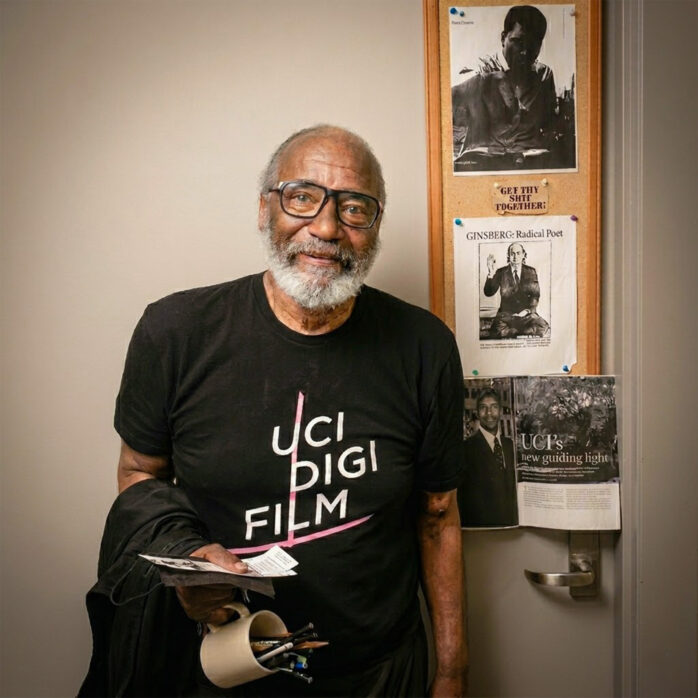
Those years at UCI were just one chapter in a remarkable career. Born in Los Angeles in 1946, Ulysses had been making video art since 1972, when the medium was brand new, picking up a Portapak when most artists hadn’t yet imagined what moving images could do in the hands of someone determined to tell different stories. Working as what he termed a “video griot,” he drew on oral storytelling traditions, structuring his work around music, poetic recitation, and dynamic performance to interrogate race, representation, and the power embedded in popular culture.

Part of what made him singular was how early he grasped what networked media could become. During the 1980s he worked with the Electronic Café, a grassroots arts group pioneering collaborative telecommunications that connected communities through interactive video, audio, and shared screens, accomplishing this decades before Skype and Zoom. Through his conceptual art band Othervisions, he explored the relationship between spoken word and lyrical content, and as artistic director of Othervisions Studio he brought that same Afrofuturist sensibility to an interdisciplinary practice that kept evolving for fifty years. He joined UCI in 1993 and spent nearly three decades shaping generations of students who went on to cite him as a foundational influence.

In the years that followed we got in the habit of having breakfast at Pann’s near his place every few weeks, as Ulysses became a regular part of my life. The staff adored him and always greeted him by name. I think the idyllic atmosphere of that diner was a kind of antidote to the exhausting ritual of dialysis that took up so much of his last few years. As we were sitting in Pann’s just a couple of days before he passed, he looked across the table and remarked, “This place. All these different kinds of people, together, getting along, in times like these. It’s so wonderful.” Never one to complain very much, Ulysses would often muse this way. He was one of the most relentlessly positive people I knew and at the same time one of the most brilliant. Celebrated in recent years for his visionary understanding of media and politics, Ulysses had that rare gift of intuiting novel ideas. As I was dropping him back at home that day, a different kind of mood hung in the air. Call it a premonition or something else, but I felt I had to tell Ulysses how much his friendship meant to me, both now and across the decades. Looking back now, I realize that he had been extremely frail that day. We even spoke about it briefly and he said he planned more walking. I guess I thought he would bounce back yet one more time.

Inclusive Teaching 2.0: The Challenge of Equity in Anti-DEI Times

These days American universities find themselves at a peculiar crossroads. With the stroke of a pen, federal actions have swept away diversity, equity, and inclusion (DEI) programs at institutions dependent on government funding. Yet in this moment of apparent retreat, one might discern not an ending but a beginning, creating the potential for a more profound transformation in how we understand the art of teaching itself.

The moment demands reinvention, not retreat. For decades now, inclusive teaching has been quietly revolutionizing classrooms, operating not by privileging some students over others, but by ensuring all students can thrive. The principle, though deceptively simple, borders on the radical: every learner deserves access to tools that support their academic growth. This principle can guide institutions toward a universal model of excellence, grounded in research, focused on outcomes, and aligned with the values of higher education.

Never has the need been greater. Today’s college student defies easy categorization. The stereotypical image of young adults attending full-time classes on residential campuses has given way to something far more complex, with  students juggling work commitments, family responsibilities, and extended degree timelines to manage costs.[1] This demographic shift demands nothing less than a pedagogical evolution, one that acknowledges students’ multifaceted lives while maintaining academic rigor.

Enter Universal Design for Learning (UDL), an evidence-based framework offering a compelling vision for the future. UDL is defined as “a framework developed to improve and optimize teaching and learning for all people based on scientific insights into how humans learn.”[2] Grounded in cognitive neuroscience and educational research, UDL principles encourage educators to present information in multiple ways, offer students various methods for demonstrating understanding, and foster engagement through real-world relevance and autonomy. Continue reading “Inclusive Teaching 2.0: The Challenge of Equity in Anti-DEI Times”

When School is a Factory

For 20 years, I have been teaching large arts and humanities general education courses at the University of California, Irvine. These 400-student classes are part of the undergraduate “breadth requirements” common in most colleges and universities, and hence draw enrollments from across the academic disciplines. At UC Irvine, this means that most of the class comprises science, technology, engineering, and math (STEM) majors. Aside from an orientation to more practical fields, I’ve noticed a clear shift in student attitudes in recent years –– a heightened preoccupation with grades and rankings, combined with growing anxieties about future earnings. Many of my colleagues see this as well, often disparaging students more concerned with GPA metrics than learning itself, while increasingly behaving more like consumers of educational commodities. I take a more sanguine view.

Bear in mind that many of today’s college students grew up during the Great Recession, when families of all incomes had money worries. With scant knowledge of a world before 9/11, it’s little wonder that polls show millennials expecting lower earnings than their parents, seeing the United States on a downward spiral, and believing the two-party system as fatally flawed.[i] Rising income inequality doesn’t help matters, especially at UC Irvine where 6 in 10 students get financial aid and half are the first in their families earning a college degree.[ii] Because of this, Irvine has been cited by the New York Times as the country’s leading “upward mobility engine” –– making the campus a national model of what public higher education can do.[iii] But it’s still not a cake-walk for degree seekers. As at most public universities in America, the majority of Irvine’s full-time students also work at jobs to make ends meet.[iv] Continue reading “When School is a Factory”

Creativity During Crisis: Do We have What it Takes?

History has shown that crisis brings out creativity, as people find themselves facing unexpected challenges and innovating out of necessity. Countless innovations and scientific breakthroughs have come from disasters and wars – penicillin, jet engines, and the internet to name but a few. Can we muster this same energy in these stay-at-home days of coronavirus?

I’ve been getting this question from University of California undergraduates in a creativity class I teach (now online, of course). Many are looking to creativity to feel better, but say they don’t know how. I reply that we are all acting creatively in countless ways, but rarely recognize our actions as such.

There is nothing unusual in this creative disconnect. Recent surveys show 80% of the American public seeing creativity as essential to their lives and work, but that 70% think they just don’t have it in them. Much of this comes from misguide views about creativity, often coming from stereotypes about natural talent, inherent genius, and artistic originality.

The problem has structural roots. For years researchers have reported a “creativity crisis” in American schools and business, generally due to risk-avoidance owing to economic anxiety. Students are obsessed with grades and future earnings, while companies stick with what already works. This results in a climate of lingering anxiety, only amplified by a fear-driven formulas of much news and entertainment.

With nowhere to turn, a stressed-out America now runs to the now-booming self-help industry, which promises salvation in finding one’s “inner artist” or regaining the “magic” of childhood. The coronavirus epidemic has pushed this trend to new heights, as consumers search for answers from external sources.

The result is a growing panic as people scramble to find, build, or otherwise maximize their creative profiles – often blaming themselves when they fail. And of course failure is inevitable, since recognized forms of creative success place it out of reach for ordinary citizens. An entrenched culture of media celebrity props up this view.

It’s time to view creativity as the universal quality it really is.  All of us have it, just like we have intelligence.  But like the failures of I.Q. testing long ago revealed, the problem lies in valuing only certain types of ability. This not only leaves out anyone who isn’t an “artist,” but it’s often loaded with biases against those lacking the time or resources to gain conventionally-recognized skills.

Especially in this moment of crisis, we need to embrace the “everyday creativity” in the typical things we do in solving simple problems, improvising around the house, or making a meal from leftovers. The online popularity of DIY mask-making is a great example of this, although, once again, few see this activity as a “creative” pursuit. Ditto for postings on Facebook, Instagram, or Twitter –– all so ubiquitous that their creativity seems inconsequential.

This dismissal of everyday creativity also comes in part from beliefs that “creative” always means something “new” or “original.”  The truth is that most famous creatives borrowed from the past or built of work by others. Michelangelo copied classical sculpture, much as Shakespeare did with ancient myths. And no, Steve Jobs did not invent the iPhone by himself.

Cognitive science says that mimicry is an essential part of human learning and communication. Researchers explain that most creativity is “combinational” in that we put together already known or found elements to create something else (like decorating a room). This can lead to “exploratory” creativity when combinations produce unpredicted outcomes (making up a new recipe).  Creativity never comes from a vacuum.

Generosity is another important part of creativity. This is because nearly all creative acts are done with someone or with some recipient in mind. Psychology long has recognized that doing for others returns self-esteem to the giver. In everyday creativity this comes from that satisfaction of begin appreciated, needed, or simply connected to others.

One joyful example of this of such social creativity is the global “clap-for-carers” phenomenon happening daily all around the world. Usually at 7 or 8 pm, homebound people go to their windows and doorways, and start clapping, hooting, or banging pans to recognize health care workers who are risking themselves to save lives.

It’s a spontaneous creativity much like that seen at rock concerts, now transformed as a collective affirmation. The beauty of these ordinary forms of creativity lies in their availability to everyone. We all can be creative if we realize that we indeed to have it in us, use it all the time, and need to give ourselves credit.